Fiber deployments: June and July 2014

While analyzing the fiberoptics industry with KMI more than a decade ago, I became accustomed to following announcements of fiber network expansions.  I can’t seem to break that habit.  Here’s a small sampling of announcements from around the world over the last couple of months:

In Paraguay, TeleGeography reports about wireless carrier Tigo’s planned US$120 million expansion of its fiberoptic backhaul network.  The article notes that Tigo’s network currently spans 5,693 km.

TeleGeography also reports about Algerie Telecom’s plans to add an additional 20,000 km to its existing 57,000 km fiber network by the end of 2015.

Lightwave reports that Allied Fiber has opened up the first segment of the southeast portion of its planned national dark fiber network; the newly available segment is a 360 mile span from Miami to Jacksonville.  I’ll let you read Lightwave’s article for more info, including the fiber count and type of fiber installed.

In undersea cable news, I spotted a couple of recent announcements, as well.

As noted in this Light Reading article, Hibernia has recently begun construction on a 4,600 km Hibernia Express undersea cable connecting North America with the UK.

Meanwhile, per this InterAksyon.com report, the Philippine Long Distance Telephone Company is the lead investor in the 20,000 km Asia-America Gateway (AAG) undersea cable, connecting Southeast Asia and the Philippines with Hawaii and the U.S. west coast.

FTTH around the world: Some June and Early July Updates

Of course, FTTH news always catches my attention.

Total Telecom quotes FTTH Council Asia Pacific president Bernard Lee’s statement that the FTTH subscriber count in the Asia-Pacific region is expected to reach 100 million in late 2014.

In South Africa, TeleGeography reports that MTN SA has connected it first FTTH subscribers in Monaghan Farm, 30 km north of Johannesburg.  Telkom SA also announced its FTTH plans in suburbs of Johannesburg, Pretoria, Durban and Cape Town.  And Vumatel, in addition to its potential 2,100-home deployment in the Parkhurst suburb of Johannesburg, has announced plans to roll FTTH out to 200,000 homes across 100 locations in South Africa.

In the U.S., Lightwave reported about the progress of the municipal FTTH network in Loma Linda, California (all businesses and 1,600 houses are on-net, with 800 more home connections expected in the next 3 years) and the upgrade of Blue Valley Tele-Communications’ FTTH network serving 7,500 customers across 17 communities in Kansas.

Elsehwere in the U.S., Ethernut reports that a third neighborhood in Ridgeland, MS has passed C Spire’s 45% preregistration threshold required to qualify for deployment of 1 Gbps FTTH.

Richard Jones’ The Business of NGA/FTTX linked to a great telecompaper article noting that Telefonica’s 100,000 new Movistar customers in April and May bumped its total number of customers in Spain past the 800,000 mark.

And in Réunion, TeleGeography reports that Zeop has lit its FTTH network in Beausejour. Because how often do I get to mention Réunion Island?!

That’s just a sampling of recent FTTH announcements. So much going on in so many places! And yet, since I covered the industry in its early stages, I’m always drawn to industry updates.

Hope you’ve enjoyed the recent news excerpts assembled above.

And just for kicks, I’ll close this post with a “Throwback Thursday” link to a February 2002 CED article called “FTTx: An Unreal Reality Takes Shape,” which cited numbers from my 2001 KMI report on the FTTH industry (and in which I’m quoted).

Potential for Telecom Provider Consolidation in Europe & Beyond

I don’t really have much to add to Tim Poulus’ Communications Breakdown blog post I’m about to cite.  Thanks to Rob Powell’s tweet this morning, I stumbled across this great Communications Breakdown blog post summarizing the potential for consolidation in the telecom industry (with most of his examples in Europe, it appears), featuring carriers as “hunters,” “the hunted,” and “undecided.”

Indeed, it’s such a good post, I won’t add anything, but on the heels of my mostly U.S.-focused (well, at least half U.S.-focused) post from a couple weeks ago, I thought this might be an interesting international follow-up.

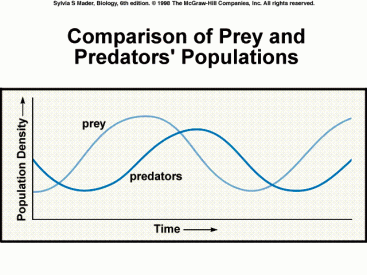
Oh, and the Communications Breakdown post contains this interesting graphic from a biology text, too.  (Bonus points for being clever.)

Comparison of Prey and Predators’ Populations


Carrier Consolidation Update: June 2014

I haven’t had time to formulate thoughtful analyses of any news items recently, but I have been noticing a lot of news about telecom carrier mergers lately, so I thought I’d summarize some of what I’ve seen… with links, of course, if you want to delve further into any of them.

TeleGeography reports that it sees cellular consolidation on the horizon in India, as the country’s top three cellular carriers dominate the market.  If that happens, India’s wireless industry would simply be joining the ongoing consolidation trend in telecom.

Here in the U.S., we’re following the merger chatter surrounding T-Mobile and Sprint.  BGR’s Zach Epstein provides the details in his overview, referencing CNBC’s video discussing the $2 billion break-up fee and the plans to go with the T-Mobile name and management team post-merger.  Meanwhile, AT&T CEO Randall Stephenson has been widely quoted as noting that a Sprint-T-Mobile merger would reduce the “big four” to a “big three,” the same reasoning cited for disallowing an AT&T-T-Mobile merger three years ago.  Obviously, T-Mobile and Sprint are hoping a merger of the 3rd and 4th largest carriers is more palatable to the FCC and DoJ.

In Europe, the talk is about Telefonica’s proposed acquisition of German wireless carrier E-Plus from KPN.

In the Italian wireless space, Reuters has reported a restart of negotiations between Hutchison Whampoa and Vimpelcom to merge their Italian wireless subsidiaries.  This report came just a week after Hutchison gained final EU approval of its Irish subsidiary’s acquisition of Telefonica’s wireless business in Ireland.

Back in the U.S., on the video side, AT&T continues to push ahead with its proposed acquisition of DirecTV, while Comcast and Time Warner Cable pursue a mega-merger.  In fact, this article suggests the AT&T-DirecTV deal may help boost the likelihood of regulatory approval for Comcast-Time Warner.

One of the interesting aspects of the AT&T-DirecTV acquisition is the role NFL Sunday Ticket plays in the deal.  As this Digital Trends article points out, there is reportedly an opt-out clause for AT&T if DirecTV fails to renew its deal with the NFL.

Meanwhile, Fierce Telecom’s Sean Buckley notes that Level 3 is looking to vastly expand its access on on-net buildings with its proposed acquisition of tw telecom.

I’m sure I may have missed a few, but those are the deals I’ve noticed in the news lately.

Carrier Ethernet Quick Hits: Price Declines Accelerate; Allstream Gets Certified, So Does Cox

Carrier Ethernet has been in the news a bit lately.  Here are a few quick hits:

1) In its CommsUpdate, TeleGeography noted that Ethernet pricing isn’t just declining; rather, it’s decline has accelerated in the past year:

New data from TeleGeography’sEthernet Pricing Service reveal that as Ethernet service availability has grown around the world, price declines have accelerated. Between H1 2013 and H1 2014, median monthly lease prices for 100Mbps point-to-point Ethernet over MPLS (EoMPLS) pseudowires declined an average of 44%, compared to 26% annually since H1 2011.

You can see the acceleration very clearly in TeleGeography’s graphic:

2) Canadian competitive carrier Allstream is trying to differentiate itself via MEF CE 2.0 certification:

“I am proud that Allstream is the first among Canada’s major national carriers to achieve this significant milestone,” said Allstream President Michael Strople. “The MEF CE 2.0 certification reinforces Allstream’s reputation for innovation and provides assurance to our customers that the products and services they are buying are the best in Canada and the world.”

3) CED reported that, in the U.S., Cox Business became the fourth cableco to earn MEF CE 2.0 certification, joining Time Warner Cable Business Class, RCN Business, and Comcast.

4) So, how many MEF CE 2.0 carriers are there?  Yes, I was wondering, too, so I went to the Metro Ethernet Forum website, where I found this Services Certification Registry.  As of this writing, 74 services, offered by 26 companies in 12 countries, are MEF CE 2.0 certified.  (A lot more companies — 72 in 27 countries– are MEF CE 1.0 certified.)

So that’s today’s tour around the Carrier Ethernet space.  I had noticed a flurry of mentions in the last couple of weeks and was curious what was going on in the space.  Perhaps this summary has satisfied your curiosity, as well.  If I missed any other interesting recent Metro Ethernet news, please do share links in the comment section (or you can send it to me and I’ll share it, if you’re one of my industry friends and contacts who doesn’t want to comment yourself).

Learning the Basics: Fiberoptics Webcast and Small Cell Definitions

How many of us have the time to keep current (or refresh our knowledge) on telecom topics that don’t affect our daily work?  I’ve recently had a couple of opportunities to improve my knowledge – one a webcast about a telecom technology, the other a blog post that helps define a newly hot market segment – that I’d like to share with you.

First, I can’t believe that it has been more than a decade since I last worked directly in the fiberoptics industry.  (My years working in the fiberoptics for KMI are also the reason I’ll always write “fiberoptics” as one word rather than two.)  Last week, I refreshed my knowledge of fiber basics by watching a “Fundamentals of Fiber Optics” webcast.  Available on-demand here on the Lightwave website, the presentation by The Light Brigade’s founder Larry Johnson serves as a solid one-hour primer covering the basics of how fiberoptics works.  Very worth viewing as a sort of refresher if you haven’t worked with the basics of fiberoptics for a while (as was my case) or if you’ve not been directly working with the theory of how fiberoptics work for a while.  Also a great introduction – something that might be worth sharing with newbies in your company.

The other interesting discovery this past week – this one definitional in nature – comes courtesy of CommScope’s blog.  Recently, I had been seeing a flurry of news articles about small cells.  This doesn’t affect my daily work, so I was comfortable with my general understanding of what small cells seemed to be, but in the back of my head I had thought I should someday devote a little time to Googling small cells just to make sure I wasn’t misunderstanding what I was reading.  Then, earlier this week, CommScope’s June 2nd blog post of “What Exactly Is a Small Cell?” found its way to my inbox.  Adapted from Pankaj Gandhi’s May 22nd post on ETTelecom’s TeleTalk blog (Small Cells: The solution to telcos’ network capacity challenges), this post serves as a nice starting point in accelerating my understanding.  Indeed, in it, Gandhi says “Small cells or small cellular base stations encompass a number of different technologies but one could describe them as anything that’s not a typical macro site.”  I’d suggest reading the entire blog post for more detail.

It’s always nice to find some shortcuts that help maintain or upgrade our understanding of the industry in which we work (and adjoining industries). I hope those two resources above are of assistance to you.  Please do feel free to share other educational resources, either by e-mail to me directly or in the comment section below.

Finally, before I close, I’ll add one more “learning tool.”  I don’t plan to make a note about this again; just, since so most of my readers right now are people I already know (industry friends, former colleagues, and contacts, many of whom don’t spend a lot of time reading blogs), I thought I’d share “how to sign up for blog e-mails.”   Look for the “Follow” button in the bottom right-hand corner of your browser window.  If you click that button, you can sign up to have my blog sent to your inbox whenever I update it.  As you can see, I don’t blog that often.  I can’t imagine it will ever be more than once a day, almost certainly not even that often, so I won’t fill your inbox.  Anyway, if you sign up for the e-mails, you won’t have to periodically click on your bookmark to my blog to see what I have to say.  (I also tweet on Twitter and pin a link to Pinterest whenever I add a new blog post, but you know how quickly those messages get lost in the feed, so e-mail is often the best way to make sure you receive each post.)

Cisco, Alcatel-Lucent, Huawei, Juniper maintain carrier router/switch lead, but SDN causes carrier pause – FierceTelecom

Cisco, Alcatel-Lucent, Huawei, Juniper maintain carrier router/switch lead, but SDN causes carrier pause – FierceTelecom.

Yes, this article is a couple months old, but I’m sure a lot of my friends and contacts who work for telecom carriers don’t follow news items like this particularly closely (you know who you are) but would still be interested in the results of the Infonetics study quoted in the article.

As the article notes (and here’s the link to Sean Buckley’s FierceTelecom article one more time, just for good measure, before I quote it):

While the top four router/switching vendors Cisco (Nasdaq: CSCO), Huawei, Alcatel-Lucent (NYSE: ALU) and Juniper Networks (NYSE: JNPR) maintained their dominant market positions in 2013, fourth-quarter carrier router/switch revenue declined 4 percent from the same period a year ago.

The article's accompanying graphic

Nothing much to see here, though revenue is slightly down.  Cisco, Huawei, Alcatel-Lucent, and Juniper still dominate.

Carrier router/switch data may not keep us yawning for long, though, as Infonetics analyst Michael Howard says “change is in the air.” You can read more about that here, in the Infonetics press release about the report featured in the FierceTelecom article.

Yeah, not my sexiest post, but I had this article squirreled away in hopes I’d get the blog up and running so I could share it.  Indeed, you can trace my interest in switch vendors back to my years working with ILECs.  If you’ve read this far, perhaps that’s where you developed your interest, too.

Quick Hits (Fiber Edition): Metro Fiber Deployment, Fiber Leasing, FTTH Speeds, FTTH Penetration

Because of my years as an analyst with fiberoptics research firm KMI, I’ve always noticed fiber deployment articles and press releases.  Here are a few recent fiber network articles:

From a CLEC perspective, tw telecom is expanding its metro network in Nashville from  the city center out to the west side of the city.  This is in line with tw telecom’s November 2013 announcement that it had planned to expand its metro networks to 5 new markets and within at least 27 existing markets within a year.

Elsewhere, Shentel (Shenandoah Telecom) is seeing growth in its fiber leasing revenue.

Another carrier announced its intention to provide 1 Gpbs FTTH service, with Cox joining AT&T and Google Fiber in the FTTH speed arms race.

Turning to Europe, telecompaper reports on the growth of FTTH connection in Spain – 85% year-over-year in January to 650,000.  An interesting point in the article is a statistic about total fixed broadband connections (not just FTTH): A vast majority of new broadband connections were added by alternative network operators, with Telefonica and cable operators adding a much smaller number.

And while we’re on the topic of FTTH, though I don’t really have much to say, this is an interesting read I ran across recently that’s probably worth sharing.  It’s a bit of a chat about FTTH in Africa with some of the writer’s personal experience with an eye to history.  At one point, to put FTTH in Africa in context, it references a Google Africa Blog article that notes “only 16% of Africa’s 1 billion people are online.”  Again, this is a rather disconnected paragraph, but it’s interesting, nonetheless, and worth sharing.

That’s what’s drawn my attention the last few days, at least from a fiber perspective.  As always, the purpose of this blog is to share what I read and some thoughts about it with old friends and contacts in the telecom industry, as well as anyone I haven’t met who will find this interesting.  Obviously, today’s post was more news and less opinion.  Hope you’ve found it helpful.

Quick Hits: Net Neutrality, Paid Peering, Wi-Fi Hotspots, and a Johannesburg FTTH Deployment

I’ve been a little buried lately and haven’t had time to put a lot of thought into another blog post, but lest you miss out on anything, here are a few interesting reads from the last couple of days:

1) Thanks to Todd Spangler’s Twitter feed, I spotted today’s FCC blog post about Net Neutrality by FCC Chairman Tom Wheeler.

2) Also worth noting is Netflix’s “paid peering” deal with Verizon (along the lines of its deal with Comcast), as per this article on the Time website yesterday.

3) What’s so interesting about that?  Well, perhaps you missed the brouhaha about Netflix VP of Content Delivery Ken Florance’s blog post last week, accusing Comcast of “double dipping by getting both its subscribers and Internet content providers to pay for access to each other,” as quoted in this FierceCable article, which even shows an interesting chart of before-and-after speeds that was included in Florance’s blog post. If you’re curious, here’s the link to the original post in the Netflix blog.

4) Today’s CED article about the CableWiFi Alliance reaching 250,000 hot spots recalls my own post from a couple weeks ago about wi-fi adding value to a landline/cabled brand.  In this case, it added value is the ability to roam.

5) Many of you who know I have a special interest in FTTH – heck, it’s how I made a name for myself, at least among those who knew my work more at KMI than a decade ago.  So you will not be at all surprised that I’m adding this last piece.  Adam Oxford wrote this ZDNet piece about a FTTH pilot in Johannesburg that, per the article, “has laid claim to being the first to offer 100Mbps fibre to the home (FTTH) on the continent.”

That’s an awful lot of links for one blog post, but it’s been more than a week since my last post, so I guess I’m making up for lost time.

Retransmission Fees, Antenna Service, and Aereo

Not much grabbing my attention lately in telecom headlines, but going over the last few days of headlines, this FierceCable article about Aereo founder Chet Kanojia’s interview with Katie Couric brings up a few interesting points. To quote an interesting segment of the interview:

“There’s a market imbalance,” Kanojia said. “Nobody loves their cable company.”

While primarily concerned with his company’s rocky relationship with broadcasters and Aereo’s April 22 date with the Supreme Court to justify an over-the-air-for-a-fee TV service model, Kanojia also said that cable companies are “absolutely” pricing themselves out of the market.

For the most part, he said, this is because cable is caught in a web being spun by broadcasters that link their “crown jewel” over-the-air programming with cable channels.

“If you get these people (Aereo customers) an antenna, you would have half the value proposition in front of them–for a lot less money (than a pay TV service),” he told Couric. Broadcasters, he added, only want “to preserve the old business model.”

There are some valid points here, though the establishment of the legaility of retransmission fees as established U.S. law in 1992 cause Aereo’s arguments to be a delicate balancing act.  (Of note, retransmission fees are not legal in Canada, assuming nothing has changed since 2012.  But I digress…)  This is why Aereo must rely on the argument that it is merely an antenna service.  Ironically, that’s what cable TV started out as.  (As I learned in my intro class while getting my BA in Telecommunications, CATV originally stood for “Community Antenna Television.”)

So the first question is whether you can put access to an antenna in the cloud.  But the second question is whether that antenna in the cloud is any different from the cable company’s antenna.  Aereo is arguing that it’s a personal antenna.  (Note the apparent similarities to cable TV I point out in the previous paragraph.)  Balancing act, indeed.

Of course, Kanojia had some thoughts about retransmission fees in general and the extent to which antenna service simply expands a TV station’s local market (both to those who can’t pick up signals due to obstructions and to those who simply find it more convenient to access local stations via an antenna service alongside satellite signals and other aggregating programming [cable TV]).  Though as someone who has worked in the telecom business, I can see the advantages of maintaining that revenue stream for local programmers to continue ensuring the viability of over-the-air television, I can also make a strong philosophical case for siding with the Canadian Supreme Court.

A little digging also brought up this interesting quote in an Adweek article, a snippet from the Wall Street Journal opinion piece written by TV industry veteran Barry Diller, who is current Chairman at one of Aereo’s financial backers.  Diller makes an interesting point about retransmission fees, a battle that, from Diller’s position, may have been lost more than 20 years ago:

“Broadcasters make more money when consumers are steered away from over-the-air program delivery and toward cable and satellite systems that pay the broadcasters retransmission fees. There’s nothing wrong with that. But it seems rich for them to forget the agreement they made to provide television to the consumer in return for the spectrum that enables their business,” wrote Diller in the Wall Street Journal.

But his reminder that broadcasters use the public airwaves is interesting to consider alongside Kanojia’s quote about how broadcast TV derives a significant portion of its revenue from retransmission fees.  Not sure either of those points, however, matters to the decision of this case; they’re more likely to simply good PR that could score points with a public that would like cheaper over-the-air television.  Of course, if Aereo loses this case and has to discontinue its service, public opinion won’t matter.

Though the outcome of this case will certainly impact the general public, the philosophical arguments behind it are likely only of interest to telecom policy geeks.  If you’ve read this far, though, that probably includes you.